|
What is leptospirosis?
Leptospirosis (lepto) is a disease caused by a bacteria called Leptospira interrogans.
It can infect multiple species of mammals,
including humans, dogs, rats, mice, raccoons, skunks, opossums, cows,
and pigs. Lepto is occasionally
diagnosed in dogs in LA County.
What are the symptoms of
lepto?
In dogs: Symptoms are variable and are
most commonly associated with kidney damage
which may include fever, lethargy, low appetite,
vomiting and increased or decreased urination
and thirst. Diarrhea and liver damage or
yellowed mucus membranes (gums) may also be
seen.
In humans: Symptoms
are variable and may include fever, severe headache,
and muscle aches. In severe cases, people may have
yellowed mucus membranes, cause kidney damage and respiratory distress.
Click
here to learn more about lepto in people.
How is lepto transmitted?
Infection occurs when the urine of an infected animal contacts the eyes, nose, mouth, or broken skin of another animal or
a person. Exposure to water or mud contaminated with urine may also spread it. In the United States, most human cases of
lepto occur after recreational exposure to contaminated lakes or streams, not from dogs. The bacteria is
shed in the urine
of an infected dog. Therefore a person caring for a dog with
lepto should wear gloves, especially when cleaning up urine.
Tracking lepto in dogs in LA County:
 Leptospirosis Outbreak in Dogs in Los Angeles
County in 2021
Leptospirosis Outbreak in Dogs in Los Angeles
County in 2021
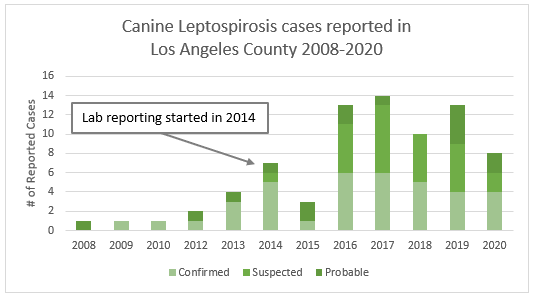
Between the period of 2008-2020:
-
77 cases reported
in dogs
-
Case categorization
based on LA County's
leptospirosis case definition for dogs
-
48% confirmed
-
19% probable
-
32% suspected
-
Vaccination history was available for 68
cases. Of these, 81% had not been
vaccinated against lepto.
-
In
2014, laboratories
were required to report cases and the total
amount of total reported cases increased
-
In 2020, one laboratory did not report as
required and the total amount of reported
cases was decreased. In addition, the
COVID-19 pandemic may have had an impact on
pets being taken in for veterinary visits
and pets being tested for this disease thus
accounting for a decrease in reported cases.
-
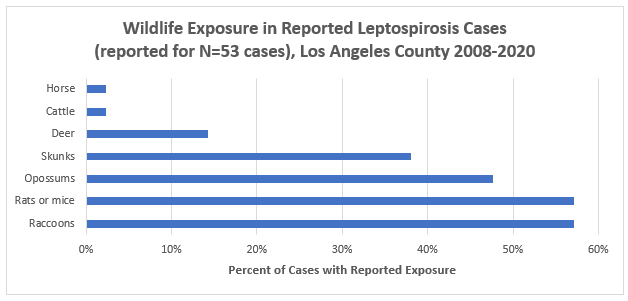
Modes of exposure
-
Most cases exposed to
wildlife, or water contaminated by
wildlife, in or near the dog's home
environment (such as
backyard
water bowls, fountains, and ponds)
-
The most common wildlife exposure in
lepto cases in dogs included raccoons,
rats or mice, opossums and skunks.
-
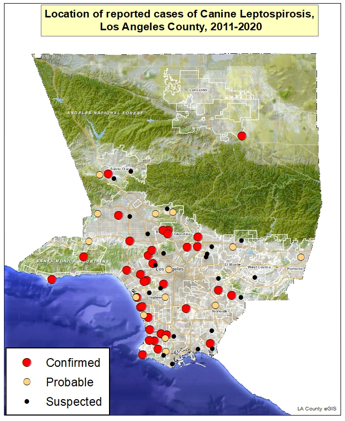
Locations of cases
-
Areas throughout LA County, no clear geographic pattern
-
Due to the cost of testing,
may be more likely to be diagnosed in
dogs in higher income areas
What is the
treatment for lepto in dogs?
Veterinarians treat infected pets by administering specific antibiotics that can kill the
bacteria. Most dogs with lepto are seriously ill
and should be treated in a veterinary hospital.
How can I protect my dog from lepto?
1. Wildlife Control. Do not attract wildlife to your yard.
Do not leave your pet's food and water outside at night.
If you have water outdoors for your pet during the day, wash and change your pet's water
bowl daily in case it was contaminated by the urine of wild animals.
If you suspect a rat or mouse infestation in your house, consult an exterminator.
2. Consider vaccinating your dog for lepto.
Local data suggest that a variety of Leptospira serotypes (strains) of bacteria may cause illness in dogs. Therefore
the 4-way vaccines (protecting against 4 strains of the bacteria) are a better choice for protection than the 2-way vaccines.
Canine Influenza and Leptospirosis Vaccine Providers
in Los Angeles County and Neighboring
Counties 12.6.21
Reporting Lepto Cases
VETERINARIANS: Report a case of leptospirosis disease by using
this form
 and email it in to
vet@ph.lacounty.gov or fax to 213-481-2375.
and email it in to
vet@ph.lacounty.gov or fax to 213-481-2375.
|
|