Veterinary Public Health
West Nile Virus in Dead Birds: Data Archive, 2007-2019
Veterinary Public Health tracked West Nile virus in dead birds until 2020. Select a year to see its maps and summary.
About This Data
West Nile Virus (WNV) is transmitted to humans, horses, and birds by the bites of infected mosquitoes. Testing dead wild birds for WNV provides a way of tracking the virus in our environment. Veterinary Public Health worked with the California Department of Public Health and local mosquito control agencies in conducting WNV surveillance in Los Angeles County.
Why test dead birds for WNV?
Tracking WNV in dead birds helps show where the virus is most active in the county. It also helps show the start and end to the WNV season.
Where does this data come from?
Members of the public report dead birds to various agencies in LA County and in California. Each dead bird is tracked, even when they cannot be tested for WNV. The Veterinary Public Health Program graphs and maps the LA County data from all participating agencies. The dead bird testing effort was in operation from 2004, the year after the virus first appeared in LA County, and has helped reveal shifts in the environmental epidemiology of the virus over the years.
As always, many thanks to Los Angeles County residents, Animal Control Agencies, wildlife rehabilitators, and Vector Control Agencies for all of your work on WNV surveillance!
Learn more about WNV
West Nile Virus in Dead Birds - 2019
- In 2019, a total of 184 dead birds were tested for WNV in LA County.
- A total of 55 birds tested positive for WNV, with a portion appearing to cluster in the West LA and Beverly Hills area.

West Nile Virus in Dead Birds - 2018
- In 2018, a total of 93 dead birds were tested for WNV in LA County.
- 19 dead birds tested positive for WNV (20%).
Freshly dead birds of any species (except pigeons and doves) can be tested for WNV. Crows and ravens are the species that most commonly test positive.

West Nile Virus in Dead Birds - 2017
- 54% of dead birds tested for WNV in Los Angeles County in 2017 were positive for the virus (as of Sept 8, 2017 - 58 out of 108 birds).
- WNV-positive birds were found across a wide area in Los Angeles County, with most being found in the San Gabriel Valley (see map).
- The WNV season started in May, as shown by the number of WNV-positive birds increasing in that month (see graph).


West Nile Virus in Dead Birds - 2016
- 66% of dead birds tested for WNV in Los Angeles County in 2016 were positive for the virus (124 out of 188).
- The number of WNV-positive birds was highest in August, the peak of the WNV season.
- Most WNV-positive birds were in the western half of Los Angeles County (see map).
- The WNV season lasted from May to November, as shown by the number of WNV-positive birds increasing and decreasing in those months, respectively (see graph).


2016 West Nile Virus in Birds and Humans - combined - Epidemiology Report (PDF)
West Nile Virus in Dead Birds - 2015
- 62% of dead birds tested for WNV in Los Angeles County in 2015 were positive for the virus (103 out of 166).
- WNV-positive birds were found across a wide area in Los Angeles County, with most being found on the west side, especially in Santa Monica (see map).
- The WNV season extended primarily between August and December, as shown by the number of WNV-positive birds increasing and decreasing in those months, respectively (see graph).
Freshly dead crows, ravens, and birds of prey may be tested for WNV.


West Nile Virus in Dead Birds - 2013
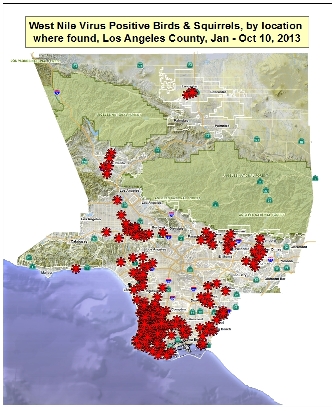
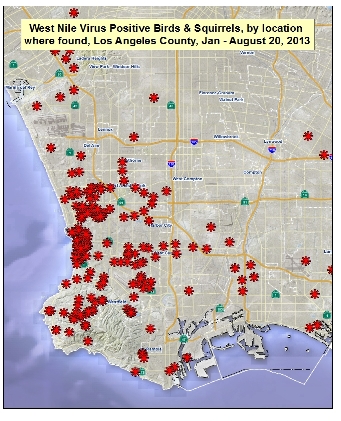
A total of 304 dead birds and three dead tree squirrels tested positive for West Nile Virus (WNV) in our county in 2013.
The state's dead bird and squirrel WNV testing program ceased operations in late August 2013. A smaller amount of testing became available just for crows in some jurisdictions. Therefore, the amount of data available on WNV in these animals decreased dramatically in August. Read about 2013 human WNV statistics for our county (PDF).
Mosquitoes transmit WNV not only to humans, but also to horses, birds, and tree squirrels. Testing deceased wild birds and tree squirrels in our county is one way to track the virus in our communities. Mosquito control districts also track the virus by testing mosquitoes. The California Department of Agriculture tests sick horses for the virus.
West Nile Virus in Dead Birds - 2012
In 2012, a total of 274 dead birds and 15 dead tree squirrels tested positive for West Nile Virus (WNV) in LA County.
Mosquito control districts also track the virus by testing mosquitoes. The California Department of Agriculture tests sick horses for the virus.

West Nile Virus in Dead Birds - 2011
Overall 2011 was a very active year for West Nile Virus (WNV). WNV was detected in 226 dead birds (200 crows, 6 House finches, 5 House sparrows, 4 Cooper's hawks, 4 Western Scrub Jays, 2 California Towhees, and a single bird each of: raven, Great Horned Owl, Oak Titmouse, Mourning Dove and Red-shouldered Hawk). There were also 15 dead squirrels that tested positive.
The number of local human cases detected was 63.
A 4-year old horse in the San Gabriel Valley also contracted West Nile Virus in August. The horse had not been vaccinated.
A significant amount of these WNV-infected birds were found in the eastern section of the county. The city of Cerritos had more WNV-positive dead birds than other cities, with 33 out of the 225 being discovered there. On the first map below, many of the WNV-positive dead birds in Cerritos appear as one red star because they were found very close together. See the second map for a close-up of this area. All but one of the WNV-positive dead birds were discovered since the beginning of June.


West Nile Virus in Dead Birds - 2010
In 2010, WNV was detected in 41 dead birds. This is a smaller number of WNV-positive birds than in 2009. (Note: Two WNV-positive birds near each other in Santa Clarita look like just one red star on the map.)
Cases of WNV infection in birds and people tend to be highest in the late summer, but may happen at other times.

West Nile Virus in Dead Birds - 2009
Movie map: WNV-positive birds in 2009 through August 18 (.wmv file, 1.2 MB)
WNV Map (updated 12.2.09)

Starting 10.8 and continuing until approximately March 2010, the state's West Nile Virus testing program (which conducts most WNV tests for LA County Public Health) discontinued testing dead birds for the winter. However, LA County Public Health is able to test individual crows for WNV during this time.
Printable version of map (PDF)
Graphing WNV (updated 1.19.10)
The number of birds tested varies by month and by year. By monitoring the percentage of tested birds that were positive, we have a way of comparing years.

- 2003: West Nile Virus first arrived in Los Angeles County late in the year (not shown).
- 2004: This was one of the most severe WNV seasons. The percentage of WNV-positive birds increased dramatically in April, and peaked in August, with 88% of dead birds collected being WNV-positive.
- 2005, 2006, 2007: These three years were much milder in terms of WNV than 2004 and settled into a consistent pattern. The season appeared to start in June each year, and peaked in August with 55% of tested birds being positive.
- 2008: A dramatic increase in WNV was seen, with the season beginning in May and peaking in August with 77% of dead birds testing positive. The reasons for this resurgence of WNV are not known. One theory is that an increase in neglected swimming pools, caused by the financial crisis, may have been a large contributor.
- 2009: The WNV season was milder than in 2008.
West Nile Virus in Dead Birds - 2008
Time-lapse movie of WNV-positive birds in 2008 (.wmv file, 1.7 MB)
The first West Nile Virus-positive dead bird of 2008 was found on April 28, and the last was found on November 25. The number of dead birds that were testing positive for West Nile Virus (WNV) in Los Angeles County in 2008 was its highest level since 2004, which was the first full year after the virus arrived in our county.
This increase may have had various causes. One theory is that the mortgage crisis led to an increase in neglected swimming pools, which created more habitat in which mosquitoes could breed.

Printable version of map (PDF)
WNV is at its greatest activity during the warmer, summer and early autumn months. The amount of WNV in the environment changes from year to year. Los Angeles County residents should always take precautions to avoid mosquitoes, which transmit the virus.
| Year | WNV-positive dead birds |
|---|---|
| 2008 | 377 |
| 2007 | 127 |
| 2006 | 63 |
| 2005 | 138 |
| 2004 | 292* |
*The 2004 number may be artificially low. In 2004, WNV testing of dead birds was stopped in ZIP codes where WNV-positive birds had already been found, in order to conserve resources. This restriction was not in place in 2005, 2006, 2007, or in 2008 (as of Sept 3, 2008).
West Nile Virus in Dead Birds - 2007


Printable version of map (Word document)