Veterinary Public Health
Bats in Los Angeles County
Have an encounter with a bat in LA County?
Call Veterinary Public Health for a rabies exposure consultation: 213-288-7060, Monday-Friday, 8am-5pm.
Choose a topic
About bats in Los Angeles County
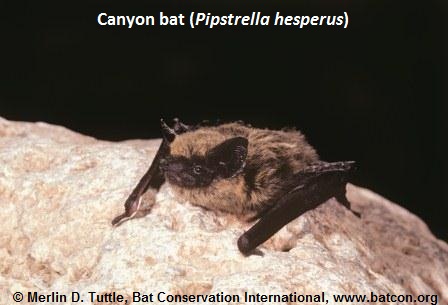
Are there any bats actually living in Los Angeles County?
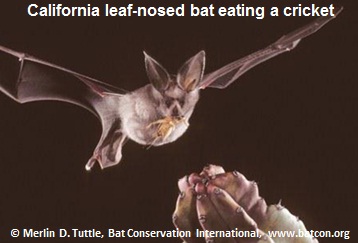
The answer may surprise you—LA County is home to a large number of bats of different species! Bats may live in urban and suburban areas, not just the countryside. Most people do not see our local bats, even when they live nearby. Bats sleep during the day, and come out at night to eat insects.
Never touch a bat (video 0:32) (opens in a new tab)
Bats are an important part of the ecosystem and help us by eating insects and pollinating plants. Healthy bats will avoid humans and other animals. On rare occasions, a healthy bat may wander into your home while following insects. Sometimes finding a bat in your home means there are others living in the attic space of your home.
If a bat has rabies, it can spread it to people or pets through bites. Only about 1% of bats in nature have rabies. However, bats that fly during daylight or have encounters with people and pets are more likely to be rabid—in recent years about 10-15% of these bats test positive for rabies in our county. In the peak months of late summer, 1 out of every 3 bats tested is positive for rabies.
Sometimes bats are found inside homes or on the ground in a yard. Encountering a bat may be a startling experience and a potentially dangerous situation, but you can safely handle the situation by following a few simple steps.
Things to remember if you encounter a bat:
- Stay calm. The bat’s intentions are not to harm you, but it will bite in self-defense.
- Isolate the bat. Make sure no pets or people are near the bat.
- DO NOT TOUCH THE BAT (or any other wildlife) with your bare hands. Wear thick gloves when you approach the animal, since an infected bat can transmit rabies through biting.
- It is illegal to keep, injure, or kill bats. Please do not attempt to rehabilitate the bat on your own or harm any bats when trying to exclude them from your house. If you find a bat in your home or on the ground, contain it and call Animal Control and ask them to collect it for rabies testing.
Bat in the house
If you encounter a bat in your home, think carefully before you release it outdoors.
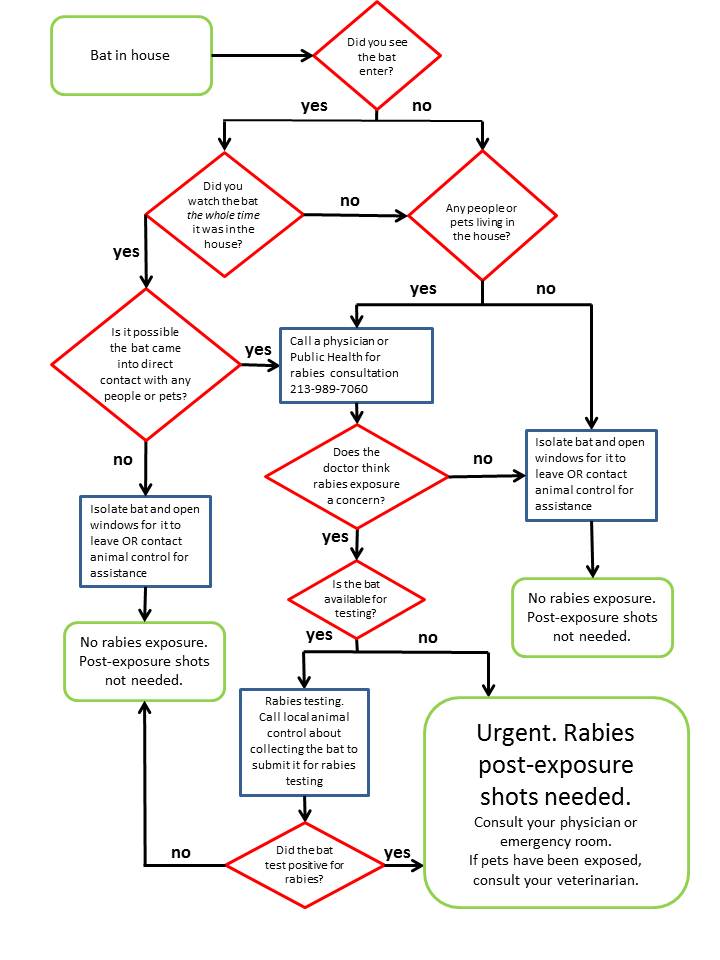
The bat might have exposed a person or pet to rabies, and might need to be tested. Please read this page carefully. This information is also available in the form of a flow chart.
Did you see the bat enter your home?
NO
This is a higher-risk situation. Los Angeles County residents should contact public health for rabies exposure consultation at 213-288-7060 (Monday to Friday, 8am-5pm). Be prepared to discuss the following questions with Public Health to determine if rabies exposure may have occurred:
- Did the bat have access to a room in where someone was sleeping?
- Are there any small children present or other individuals who may not be able to communicate whether or not they’ve handled the bat?
- Is there any way someone in your house could have been in contact with the bat or exposed to rabies?
- Do you have pets that may have come in contact with the bat?
If there is any chance someone could have come in direct contact with the bat, the bat needs to be captured and submitted for rabies testing. Call your local animal control (opens in a new tab) for assistance. If you can do so, try to safely capture and contain the bat (see below) right away to prevent it from landing on people or pets. If the test results are positive, anyone who may have come in contact with the bat will need post-exposure shots.
YES
If you saw the bat fly in and are certain that it did not have the opportunity come in contact with any people or pets, you can trap the bat in one room, close the doors, and open all windows to provide it with a chance to escape. If it does not leave call your local animal control (opens in a new tab) for assistance or refer to the "How to safely capture a bat in your home" section below. A bat bite is very small and can easily go unnoticed (especially if the victim is asleep), so please consider the situation carefully and call public health if there is any question.
How to safely capture a bat in your home
- Move children, incapacitated adults, and pets away from the bat.
- Close all doors to trap it in one room.
- Put on leather work gloves.
- Find a solid container such as coffee can, cardboard box, or plastic container, a piece of cardboard large enough to cover the opening, and tape to later seal the cardboard to the container. Punch small air holes in the cardboard. If the bat is on the floor, simply place your container over it, then slide the cardboard carefully underneath. If the bat is on a wall, gently place the container over the bat and carefully slide a piece of cardboard between the container and the wall to isolate the bat. Tape the cardboard snugly to the container. Place in a quiet shaded place, far from people and pets.
- If there was any possibility the bat had direct contact with a person or pet, contact your local animal control (opens in a new tab) to arrange rabies testing.
- If the bat escapes or is not tested for any reason, contact public health for a consultation on rabies 213-288-7060 Monday to Friday 8am-5pm.
If you are certain that there is no possibility of rabies exposure and that the bat did not come into contact with any people or any pets, wait until after night falls to complete the release. Bats tend to have more difficulty taking flight off the ground, so try to release the bat onto an elevated surface. You can release the bat by holding up the container, slowly lifting the lid, and slightly tilting the cardboard. Alternatively, you could also hold the container next to a tree or wall when you lift it, allowing the bat to cling onto a high surface.
Printable infographic
- What To Do If You Find A Bat Infographic (PDF, opens in a new tab): color printable (PDF, opens in a new tab) | black and white printable (PDF, opens in a new tab)
- Que Hacer Si Encuentra Un Murcielago (PDF, se abre en una pestaña nueva): color imprimible (PDF, se abre en una pestaña nueva) | imprimible en blanco y negro (PDF, se abre en una pestaña nueva)
View this information as a flow chart
Bats found outside
If you see a bat on the ground, do not touch it with bare hands.
Keep people and pets away from it.
If the bat is moving and appears healthy, leave it alone. If the bat is active during daylight hours, it will most likely be disoriented and may be sick. If it appears sick and shows little movement, contact your local animal control agency (opens in a new tab) and gently cover the bat with a container with air holes until they arrive. Make sure no one touches the bat.
If someone has touched or been bitten by the bat, the situation must be treated as a potential rabies exposure. You will need to submit the bat for rabies testing. Simply place a box over the animal and contact public health at 213-288-7060 as well as your local animal control agency (opens in a new tab).
If you have additional concerns about identifying a potential rabies exposure or advice on capturing the bat, please go to the Bats in the House section.
Bats in the attic
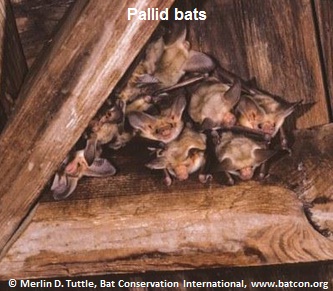
Bats sometimes roost inside attics, walls, or other parts of buildings.
If there are multiple bats inhabiting your attic or another room in your house, the best course of action is installing a one-way excluder device—a “door” that allows bats to fly out but prevents them from returning inside. This also involves “bat-proofing” your home and sealing off other potential entrances.
It is important to avoid performing exclusion procedures in the summer months (May-August) due to the baby bats that may be inside—with the exclusion device, they will be unable to obtain food and will die. Remember to be mindful of the season when preparing for bat exclusion and do not trap bats inside. Remember that it is illegal to kill bats roosting in your home.
After all the bats have disappeared, safely dispose of the guano (droppings) that they may have left behind. The droppings may not only leave a strong odor but also possibly grow mold and transmit disease, so it is best to consult a trained professional and safely eliminate the guano.
For detailed information about bat exclusion, please visit UC Statewide Integrated Pest Management Program - Bats (opens in a new tab).
Houses for bats
Are you considering building a bat house?
Bats are a very important part of our local ecosystem. Bat houses can provide protection and habitat for them. However, there are health issues to consider when choosing the location for a bat house.
When wild animals are invited into areas close to your home, there is an increased possibility of a person or pet coming in direct contact with wild animals. Before adding a bat house to your yard or garden, the following should be considered.
1. Is your home “bat proof”?
Bat houses can provide a nice roosting area for bats, but often attic or rafter space is even more hospitable. Therefore, search your home for any openings ¼ inch by ½ inch or larger (to include electrical and plumping holes) and apply caulking. Ensure all doors to the outside close tightly. Always use window screens, chimney caps and draft-guards beneath attic doors.
Avoid “bat-proofing” your home from May through August when young bats can get trapped and die. During fall and winter when bats hibernate is the best time to “bat-proof”.
Additionally, bat houses shouldn’t be mounted directly on homes as it can increase the chance that a bat may fly into the home through an open window or door.
2. How close are your neighbors?
Even if you “bat-proof” your home, your neighbors may not and your bat house could increase your neighbor’s chance of encountering an unwanted bat.
Are children or pets nearby?
Children and pets are curious by nature and may attempt to handle a bat on the ground. Therefore, bat houses should not be installed in areas easily accessible to children and pets.
3. Have you read all about bats and rabies in LA County?
It is vital to educate yourself and your family about bats and rabies in our county before building a bat house. Learn about rabies in LA County, including the latest rabid bat statistics.
Bats and disease
The two most common diseases associated with bats in the United States are rabies and histoplasmosis.
Rabies
Rabies is a fatal disease caused by the rabies virus. People can become infected when bitten by an infected bat, or when saliva of an infected bat comes in contact with the eyes, nose, mouth or an open wound. Any bat that bites or has possible contact with a person or pet should be tested for rabies. Call your local animal control for assistance. Learn how to safely capture and contain the bat (PDF, opens in a new tab).
Bat bites are very small. Some bat bites cause only minor pain. A wound from a bat bite can easily go unnoticed. Therefore if there is the possibility of contact with a bat, a physician or the Department of Public Health should be consulted to evaluate the risk of rabies. Any suspected bite should be washed with soap and water immediately and prompt medical attention sought. If there is a possibility that your pet came in contact with a bat, a veterinarian or Veterinary Public Health should be consulted to evaluate the risk of rabies.
If a person was likely exposed to the rabies virus, symptoms can be prevented with a series of rabies vaccinations given in the upper arm over a few weeks, as well as rabies immune globulin (antibodies) given at the beginning of the treatment. This is called ‘rabies post-exposure prophylaxis’ or rabies PEP. Because rabies is such a serious disease, rabies PEP is needed after any bat bite unless the bat tests negative for rabies. If it is needed after a bat incident, rabies PEP should be started as soon as possible (i.e within 1-3 days). Symptoms of rabies from bats usually start 30-90 days after the bite. If symptoms occur, the disease is nearly always fatal. For additional information on rabies in people, visit CDC: Rabies (opens in a new tab).
If a pet was likely exposed to the rabies virus, they will be either quarantined for 30 days if vaccinated for rabies or for 6 months if not. Additionally, a series of rabies vaccines would be recommended to help prevent disease. Signs of rabies usually start 3-8 weeks after the bite. If signs of rabies occur, the disease is fatal.
Histoplasmosis (opens in a new tab)
Histoplasmosis is a disease caused by the fungus Histoplasma capsulatum. It can be anywhere there is a large amount of bat droppings (guano). People can become infected if they breathe in the fungal spores. Symptoms are similar to pneumonia (including trouble breathing and coughing) and should be treated early to avoid severe disease. The risk of contracting histoplasmosis from bat guano is no different from the risk associated with bird droppings. Professional services should be sought to clean up areas with large amounts of droppings.
Bats frequently asked questions (FAQ)
1. How common is rabies? Is it common in Los Angeles County?
In a healthy bat population, rabies affects less than 1% of individuals. However, in Los Angeles County, 10-15% of bats submitted for testing are found to be rabies-positive. Bats submitted for rabies testing typically show unusual behavior and are more likely to be found, since healthy bats generally avoid contact with humans. To see where rabid bats have been found in our county, view the rabid bat map. Additional information can be found on our rabies page.
2. What would happen if a rabid bat bit me or my pet? What are some general signs and symptoms of rabies?
The rabies virus would enter the body at the bite site, travel to the central nervous system, and eventually cause inflammation in the brain. This can lead to a variety of symptoms that vary by individual and host species. Pets can undergo behavioral changes, become disoriented and aggressive, and experience seizures or paralysis. In humans, initial symptoms are flu-like (e.g. headache or fever) but quickly progress to more severe symptoms such as hallucinations, extreme anxiety, delirium, hydrophobia ("fear of water", i.e. difficulty drinking), and paralysis. Once these symptoms occur, the disease is almost always fatal.
3. What is rabies post-exposure prophylaxis (PEP, i.e. rabies post-exposure shots)?
It is a series of 4 vaccinations given in the upper arm over a few weeks, and one dose of immune globulin given at the site of exposure or bite. These shots are given to prevent symptoms of rabies when a person was likely exposed to the rabies virus.
4. What bat species are native to the Los Angeles County area?
Los Angeles County is home to many different species of bats. The Mexican free-tailed bat, California myotis, hoary bat, and Western pipistrelle are some of the most common species present.
5. What other wildlife species can transmit rabies? Are bats the only animals I should be worried about?
In Los Angeles County, bats are the primary vector for rabies. However, rabies can also be transmitted by other animals including raccoons, coyotes, skunks, opossums and foxes. Though these cases are less common in California, you should avoid disturbing wildlife and never approach or touch a wild animal.
More information
Last updated: September 28, 2026