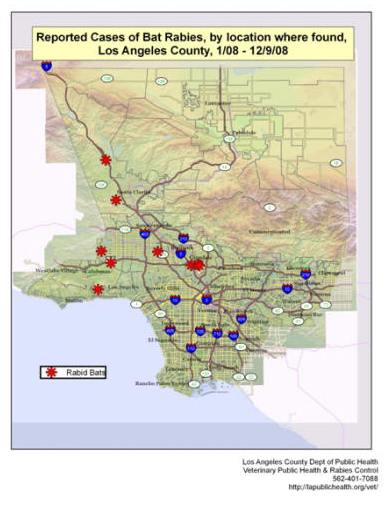
Rabid Animals In Los Angeles County. Currently
bats are the main reservoir in Los Angeles County.
In 2008, nine rabid bats were discovered in Los Angeles
County. Rabies is endemic in skunks further
north in California, from Santa Barbara County and
further north. Although rabies in other wildlife and domestic
species has not been diagnosed locally in recent years,
other species may become infected with rabies after
exposure to a rabid bat or skunk. Rabies was detected in skunks in LA County
regularly until 1978 when a wildfire killed the last
rabid colony.
The last rabid cat detected in LA County was in 1987,
when a cat incubating rabies was adopted in Acapulco,
Mexico and brought to the San Fernando Valley. The
last rabid dog diagnosed in LA County was in 1979.
Rabies in California. To see the 2007 rabies map for California
click
here.
Although the primary reservoirs for rabies in California
are bats and skunks, rabid foxes are found in
significant numbers every year. A few other
animals such as raccoons and domestic animals also are
diagnosed with rabies in our state on an annual basis,
with most cases being in northern California.
Risk
of Rabies Importation. Animals
incubating rabies may be brought to LA County from
other parts of the U.S. or from other countries that have more rabies. For example, In 2004 an ill puppy
adopted in Thailand was brought into the U.S. through
the LAX airport. The puppy was seen by two
veterinarians in LA County. The puppy was eventually
diagnosed with rabies by a veterinarian in Santa Barbara
County, where the case was officially counted. In
recent years, an increasing number of illegally-imported
puppies have been arriving in Los Angeles County, many
from
countries that still
have rabies endemic in their
dog populations.
To read more about illegal dog
imports, click
here .
Rabies may be introduced into new wild animal
populations and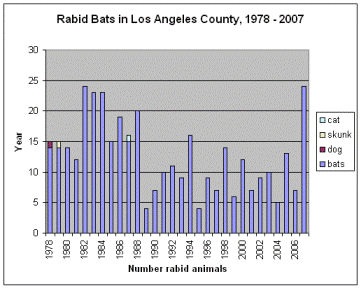 spread before being detected. This
happened on the East Coast when humans transported rabid
raccoons from Florida to West Virginia in the 1970s,
triggering an outbreak of raccoon rabies that has since
spread hundreds of miles, an outbreak that persists
today. To read more about this outbreak, click
here.
spread before being detected. This
happened on the East Coast when humans transported rabid
raccoons from Florida to West Virginia in the 1970s,
triggering an outbreak of raccoon rabies that has since
spread hundreds of miles, an outbreak that persists
today. To read more about this outbreak, click
here.
Rabies Clinical Signs. Rabies
causes encephalitis, so all signs are technically
neurological in origin. However, since the nervous
system influences all parts of the body, the first
clinical signs may not be obviously neurological.
For example, the
first signs reported in the rabid puppy from Thailand
where respiratory problems and regurgitation/vomiting, followed
later by aggression. Most likely the
regurgitation/vomiting was due to changes in esophageal
muscle tone and neurological ileus.
Early symptoms of rabies in humans include headache,
muscle and body aches, and numbness and tingling of the
body part associated with the original infecting bite
wound. Animals most likely feel these early
symptoms as well, but they are not easily detected since
they cannot talk. Clinical signs may also include
some combination of ascending weakness, disorientation,
aggression, acting withdrawn, and fear of wind and
water. Difficulty swallowing is very common in
advanced rabies, therefore the ability to eat and drink
normally is suggestive that clinical rabies is not
likely present. Eventually cases advance to
generalized weakness and coma, and may or may not
include seizures. Fever is sometimes present. Wild
animals with rabies generally lose their fear of people
and other animals, and may be passive or aggressive or
both. Once signs of rabies appear, the clinical
course is a steadily worsening one. Therefore, an animal
with neurological disease that is improving, or that has
a waxing and waning course, is generally not rabid. To
read more about clinical signs of rabies refer to our
Rabies Manual
or to this
Rabies Bulletin from the World Health Organization.