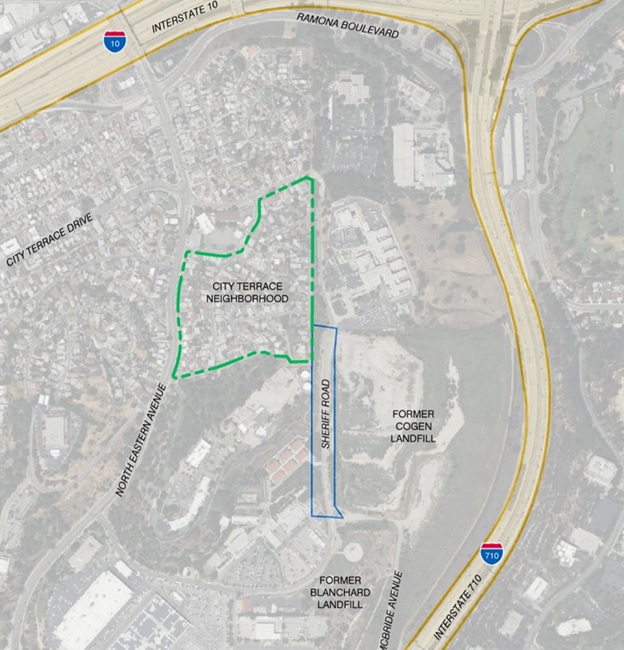
The Eastern Hill area near City Terrace contains two closed landfills, the Blanchard and Cogen
Landfills, which were operated by BKK Corporation and have been closed since 1958. While the
County never operated the landfills, after their closure, they were divided between the County
for public improvements, on Sheriff’s Road and the Los Angeles County Sheriff’s Department
Monterey Park Facilities. The remaining land is privately owned.
The County has been actively managing its portion of the landfills, including installation of
landfill gas control systems at both landfills. Crown Enterprises also installed a landfill gas
control system at Cogen Landfill, while Bar V Bar completed installation of the operational
landfill gas control system at Cogen in 2023.
For more information on County actions regarding the Eastern Hill Landfill, visit here: https://pw.lacounty.gov/projects/eastern-hill-landfill/.
In tandem with the installation of the landfill gas extraction system, the County began an
assessment of potential health risks in the City Terrace community.
The County of Los Angeles conducted soil vapor testing and outdoor air sampling to evaluate
potential human health risks in 2021 and 2023. As part of the initial sampling process, the
County conducted community outreach to the 152 homes in the City Terrace community, resulting in
29 property owners agreeing to permit subsurface soil vapor and outdoor air sampling at their
properties in August 2021.
Key study results included:
-
In 2021, sampling of 29 properties discovered elevated levels of benzene outside of the
home. The initial test did not indicate whether there is benzene inside the homes of the
residents.
-
In 2023, a second round of sampling was conducted to measure benzene, and other
chemicals in soil vapor outside and inside homes. The sample included 23 of the original
29 properties sampled in 2021. The sampling results found the following:
-
Indoor air inside the homes had elevated levels of benzene.
-
Residence indoor risk levels ranged from 4- to 700 excess cases in a
million. The higher indoor range level was a result of the chemical
sources found in individual homes.
-
Outdoor air had similar levels of benzene as the indoor air.
-
Soil vapor was not affecting the indoor or outdoor air quality.
-
The landfills have no known impact on the soil in the community.
-
The 2023 study found that vehicle emissions were the primary source of benzene in the
area, not the landfill.
-
An additional study showed benzene levels were within the expected background range in Los Angeles County. Outdoor air risk levels ranged from 4- to 10 excess cases in a million, consistent with risk levels across Los Angeles County.
The County also conducted Human Health Screening Evaluations (HHSE), calculating additional
cancer risk levels for a specified exposure. The HHSE risk numbers found City Terrace has
levels consistent with the risk levels across Los Angeles County.
Air quality in California is managed by different regulatory agencies with different roles and
responsibilities. We've gathered the information for the agencies and resources that can work
with City Terrace residents regarding air quality concerns.
County of Los Angeles
Soil Gas and Indoor Air Sampling Report
County of Los Angeles
Air Quality Attribution Study Report
Are the gases from the landfill?
The County’s findings indicated there were no landfill impacts through the soil into
the community. Vehicle emissions from vehicle emissions are the primary source of
benzene concentrations in indoor and outdoor air in the community.
Where is benzene found?
Benzene is a chemical used in the production of a wide range of industrial products,
including chemicals, dyes, detergents, glues, paints, rubbers, and some plastics. It
is also produced from refining petroleum. It is also present in vehicle emissions,
cigarette smoke and gasoline, and is produced in the combustion of wood and coal.
Benzene occurs naturally from volcanoes and forest fires. Benzene can often be found
in air near areas where petroleum products such as gasoline and fuel oil leak or are
spilled into the ground.
What is 1,3, 5 and 1,2, 4-trimethylbenzene? Is it a derivative of Benzene? Is that as
harmful as Benzene?
1,3,5 and 1,2,4-trimethylbenzene are derivatives of benzene that are naturally found
in coal tar and gasoline. They are less harmful than benzene. While benzene is a
known human carcinogen, 1,3,5 and 1,2,4-trimethylbenzene are classified as chemicals
that do not have enough information to determine if they are capable of causing
cancer.
How will this affect family time spent inside the house and the outside/patio of the
house?
The ambient air collected as part of this study does not suggest that spending time
inside and outside your home in this community should pose any increased risk.
Is the water supply affected? Can benzene enter pipes? Has anyone tested the
water?
This study did not sample or collect any groundwater for testing. However, it is the
County’s understanding that all of the drinking water used in this community is
supplied by approved providers and is piped in from outside of this community. There
is no reason to believe that the drinking water in this community has been impacted
by the chemicals detected in the soil vapor located underneath the properties.
If Benzene is in the water, how does benzene affect our skin, such as washing wands or
taking showers?
There is no reason to suspect that the drinking water in this community has been
impacted in any way by the chemicals detected in the soil vapor located underneath
the properties. The water lines are all sealed and soil vapors should not be able to
get in.
Can water be tested for benzene and other chemicals?
There is no reason to suspect that the drinking water in this community has been
impacted in any way by the chemicals detected in the soil vapor located underneath
the properties. The water lines are all sealed and soil vapors should not be able to
get in.
How often is the landfill being monitored and tested for chemical/gas releases?
Soil vapor samples are collected from both landfills and offsite locations on a
monthly basis. Results are used to monitor for soil vapors that may be migrating
from the Cogen Landfill.
What air purifier should be used inside the home? Are there reimbursements for
purchasing air purifiers?
Any air purifier that has a carbon or activated carbon filter would be capable of
removing gas contaminants (such as benzene) from the air. This is also true of any
HVAC filters with carbon or activated carbon built into the filter. There is no
reimbursement for purchasing air purifiers.
-
Newsletter - August 2023: English | Español
-
Update: Environmental Sampling in the City of Terrace Presentation - May
2023: English
| Español
-
Overview of East Los Angeles, Boyle Heights, West Commerce, AB 617 Community
Emissions Reduction Plan Presentation - May 2023: English
| Español
-
Community Air Protection Program in the AB 617 East Los Angeles, Boyle Heights,
West Commerce Community Presentation - May 2023: English
| Español
-
Community Newsletters - May 2023: English
| Español
-
City Terrace Town Hall Meeting PowerPoint Presentation - February 25,
2023: English
| Español
-
Community Newsletters - February 2023: English
| Español